
NASA's Roman Telescope Begins Cosmic Exploration
NASA's latest launch signifies a breakthrough in understanding dark energy, dark matter, and the rich diversity of exoplanets.
Published before the sentence-level fidelity gate (September 2026). Figures and attributions in this piece were re-verified afterwards; any change is recorded in the public corrections log. See /corrections →
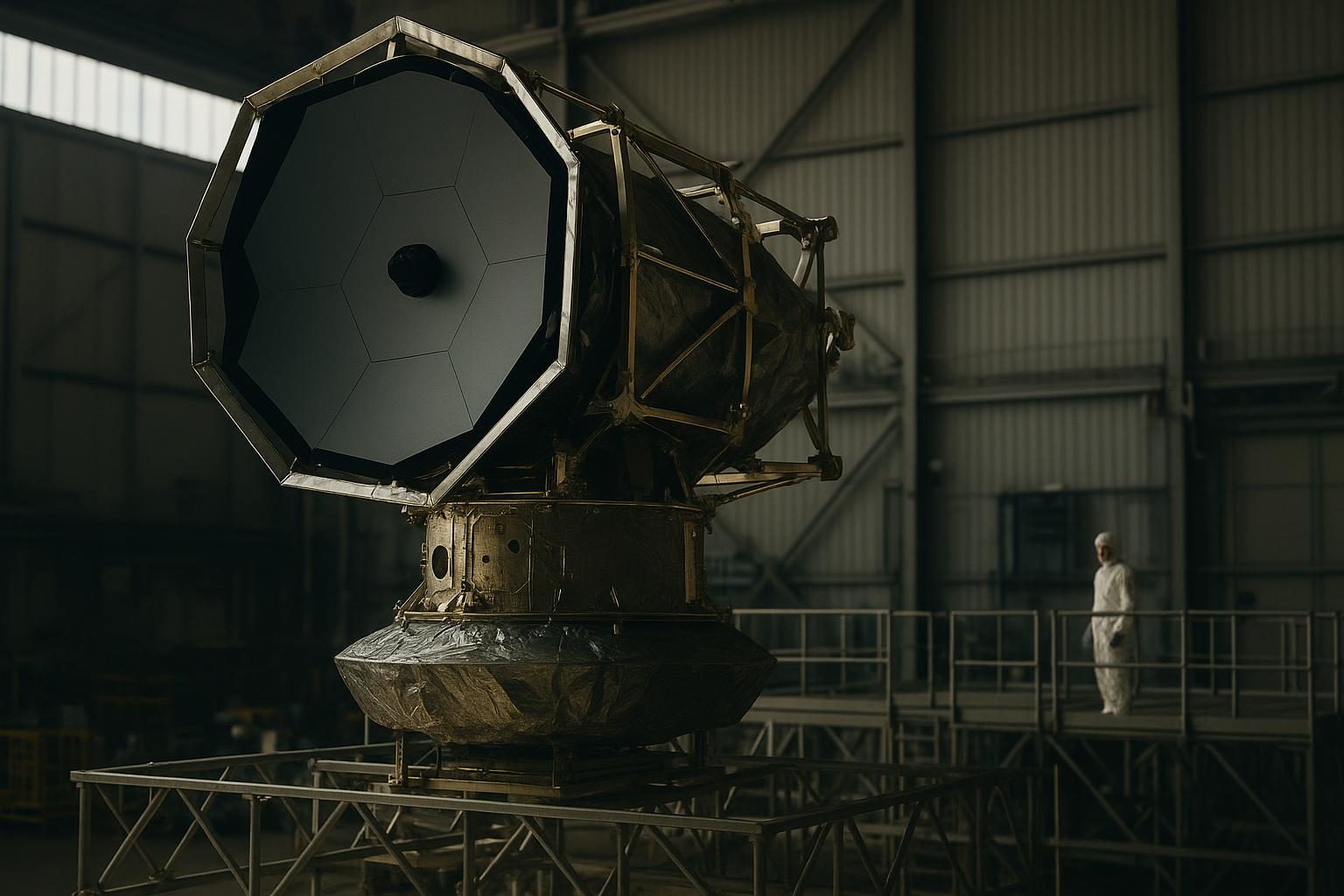
NASA’s Nancy Grace Roman Space Telescope has embarked on a groundbreaking mission to map the cosmos in unprecedented detail. Launched successfully aboard a SpaceX Falcon Heavy from Kennedy Space Center, Roman is set to unlock the mysteries of dark energy and dark matter. This mission represents a significant milestone for its scientific promise and collaborative spirit. Agencies like ESA have played an essential role in its development. As Roman travels to its new home, the Sun-Earth L2 Lagrange point, it’s clear that we’re on the brink of transforming our understanding of the universe.
The Launch that Pushes Boundaries
The successful launch of the Roman Space Telescope on August 30, 2026, signified more than another spacecraft entering the final frontier. It was the beginning of a mission that promises to change our cosmic perspective. Roman's journey to the L2 Lagrange point will cover a million miles over the next three months. Unlike any telescope before it, Roman brings a panoramic sweep at least 100 times the field of view provided by Hubble, as NASA highlighted. This expanded scope will allow Roman to survey the cosmos in infrared, presenting a broader picture of the universe than ever seen before.
A Collaborative Leap
Roman’s mission exemplifies the power of international collaboration. The European Space Agency (ESA) has provided crucial components, such as star trackers and detectors for Roman’s coronagraph. Carole Mundell from ESA expressed that their involvement is integral to achieving the mission's ambitious scientific goals. This collaboration extends beyond ESA, with the contribution of institutions like JPL, Caltech/IPAC, and even international partners such as JAXA and CNES. Nature reported that this collective effort shows a global commitment to unlocking the universe’s secrets.
Exploring Cosmic Mysteries
Roman’s scientific objectives could redefine our understanding of the cosmos. The telescope will focus on three main surveys, designed to delve into the enigma of dark energy and reveal the hidden nature of dark matter. These surveys also aim to map dense star clusters and observe transient celestial events. AP News explained that Roman’s infrared prowess will enable the discovery of countless phenomena, from multiple supernovae to a variety of galaxies, each offering clues about the universe’s evolution.
Exoplanets: A Cosmic Census
One of Roman’s intriguing aspects is its potential to expand our knowledge of exoplanets. Utilizing a coronagraph, Roman will directly image exoplanets, offering insights into their atmospheres and compositions. Space.com articulated that this capability will enable a complete demographic study of exoplanets, far beyond current capabilities. The mission will spotlight the diversity and frequency of these distant worlds, perhaps leading to unprecedented revelations about the potential for life elsewhere in the galaxy.
Efficiency and Innovation in Execution
The Roman Telescope project is as much a demonstration of engineering proficiency as it is of scientific ambition. Completed eight months ahead of schedule and under budget, Roman sets a new standard for efficiency in space missions. Its innovative design incorporates a primary mirror repurposed from government satellites, marrying practical efficiency with cutting-edge technology. NASA noted that such measures illustrate how space exploration is continually evolving, making ambitious endeavors more feasible and frequent.
The Next Steps in Cosmic Discovery
What changed: The launch of the Roman Space Telescope marks a new phase in cosmic exploration, with its advanced capabilities promising to deepen our understanding of the universe.
Measurable implication: Roman's journey to the L2 Lagrange point will cover a million miles over the next three months, showcasing its extensive travel and operational scope.
Next dated milestone: No dated milestone is scheduled; the signal to watch is the telescope's arrival at the L2 Lagrange point and the commencement of its surveys.
Strongest counterargument: The most compelling counterargument is the potential for unforeseen technical challenges that could delay or limit the telescope's capabilities. Evidence of such issues would necessitate a reassessment of the mission's projected impact.
Sources
- Roman lifts off on a mission to survey the infrared sky — ESA News · 31 August 2026
- NASA’s Dark Universe‑Seeking Nancy Grace Roman Space Telescope Launches — nasa.gov · date not available
- Lift‑off! NASA launches Roman Space Telescope to tackle dark‑energy mysteries | Nature — nature.com · date not available
- NASA’s newest space telescope launches on a quest to explore the hidden universe — apnews.com · date not available
- ‘It’s going to do things that currently are impossible’: The Roman Space Telescope… — space.com · date not available
MktInvest Research is MktInvest's automated research desk. Every piece is AI-generated and machine-gated — no human byline is implied. How this works →
Get this in your inbox, weekly
The Friday digest: what changed on every market we track — stances, evidence movement and the facts behind it.
Marketing communication for informational purposes. It does not constitute financial advice or a personalised recommendation (MiFID II). Exposures are discussed at asset-class/ETF level only.