
NASA's Roman Telescope Launches Early, Promising New Discoveries
Launching ahead of schedule, NASA's latest mission promises groundbreaking insights into the cosmos.
Published before the sentence-level fidelity gate (September 2026). Figures and attributions in this piece were re-verified afterwards; any change is recorded in the public corrections log. See /corrections →
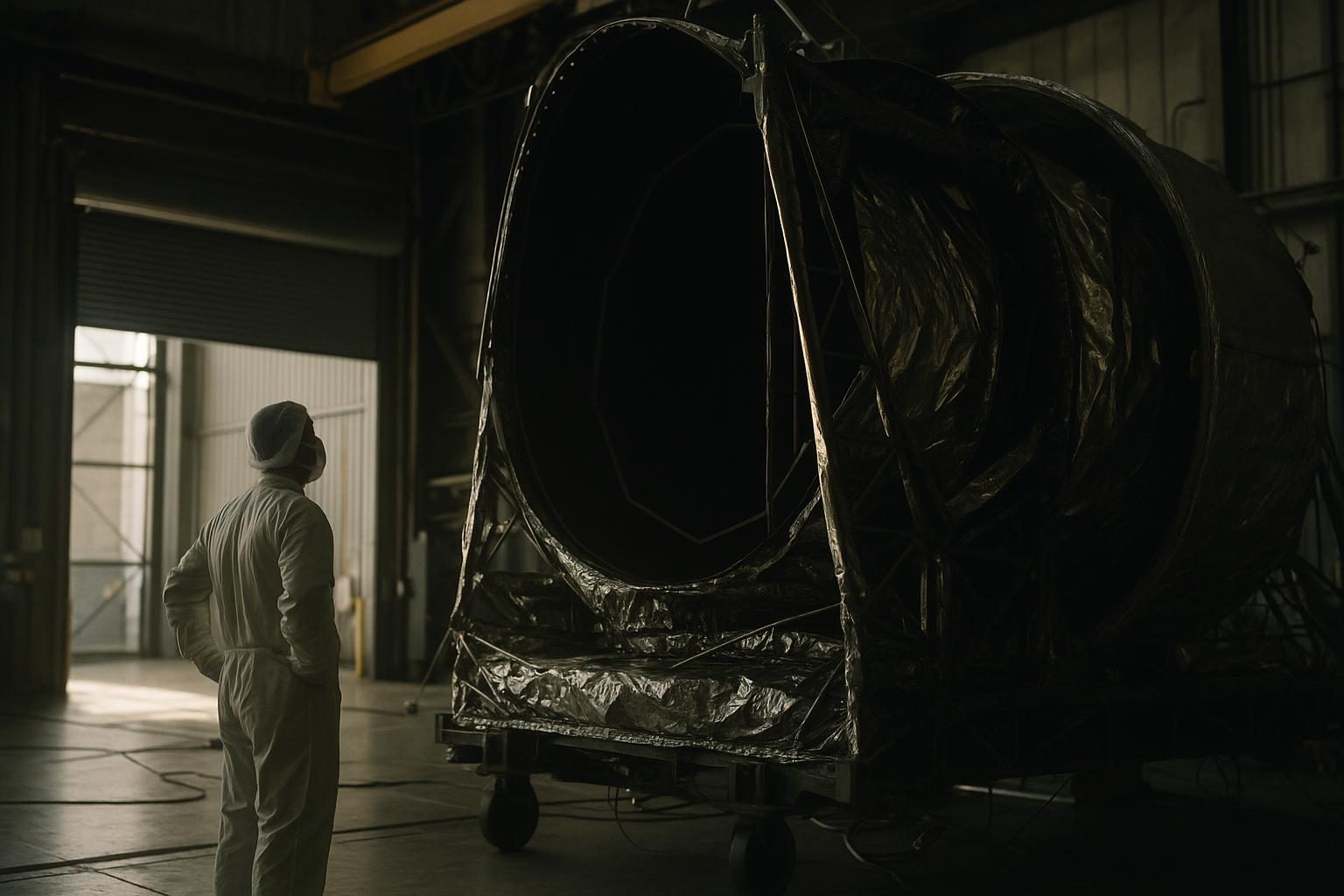
NASA's Nancy Grace Roman Space Telescope is set to launch this coming August, a full eight months ahead of schedule. This achievement marks a significant milestone in the cost-efficient execution of space missions. As this monumental project prepares for liftoff, it holds the promise of revolutionizing our understanding of the universe, offering insights into dark energy, exoplanets, and the very structures that make up the cosmos. Its early completion is a symbol of innovation and collaboration, pointing to a future where space science becomes increasingly agile and responsive.
Achieving the Impossible: A Timely Launch
In space exploration, staying on schedule is rare; advancing a launch date by eight months is almost unheard of. Yet, this is precisely what the Nancy Grace Roman Space Telescope project has accomplished. Initially set for a later launch, the mission has rapidly progressed through crucial milestones. NASA's updates include the arrival at Kennedy Space Center, the achievement of vertical integration, the thorough inspection of solar panels, and the fueling process involving approximately 290 gallons of hydrazine propellant.
What sets Roman apart is its strategic operation from a Sun-Earth Lagrange Point 2 orbit, situated about one million miles from Earth. This location offers a stable, unobstructed vantage point ideal for deep-space observations, akin to the perfect perch for a celestial opera. With its 2.4-meter primary mirror, identical in size to Hubble's, Roman boasts a much wider field of view, poised to survey billions of galaxies and unveil thousands of exoplanets. Such technological prowess marks a new chapter in our cosmic exploration narrative.
Collaboration: The Key to Space Exploration
NASA's Roman Telescope exemplifies the power of collaboration. Managed by NASA’s Goddard Space Flight Center and with contributions from notable institutions such as JPL, Caltech/IPAC, STScI, Ball Aerospace, L3Harris, and Teledyne, the project highlights the global spirit of scientific endeavor. Each entity brings its expertise, forming a mosaic of innovation and determination that propels the mission forward.
The media buzz surrounding the upcoming launch is palpable, with NASA opening accreditation for coverage well in advance. This speaks volumes about the anticipation and excitement in both public and scientific domains. The synergy of multiple agencies and private companies fosters a shared sense of achievement and wonder aimed at unlocking the mysteries of the universe.
Science for All: Democratizing Data
One of the most striking features of the Roman mission is its data policy, established to democratize space science. During its primary mission, which spans five years with possible extensions, Roman will generate data volumes into the hundreds of terabits per day. In a groundbreaking move, NASA plans to release this data publicly without a proprietary period. This approach will democratize access to cutting-edge research and science, fueling curiosity and learning in ways we've not seen before.
The impact of such transparency is profound. It enables scientists worldwide, regardless of their funding or institutional backing, to dive into the data, collaborate, and innovate at unprecedented scales. In an era where data is power, NASA’s initiative to release the telescope's findings to the global community marks a progressive step toward an inclusive scientific environment.
A Precedent for Future Missions
The early launch of NASA's Nancy Grace Roman Space Telescope signals more than just the progress of a single mission. It embodies the possibilities of agile project management and collaborative innovation, setting a precedent for future missions. The telescope’s findings are expected to unravel some of the universe's oldest and most profound mysteries regarding dark energy and matter, potentially rewriting textbooks and broadening the horizons of contemporary astrophysics.
Moreover, the Roman Telescope paves the way for future explorations, illustrating a model where efficiency and collaboration are paramount. Future missions could derive a valuable template from Roman’s execution, moving from arduous timelines to a more dynamic and responsive scientific inquiry.
The Next Steps in Space Exploration
What changed: The Roman Telescope's early launch represents a shift toward more agile and efficient space missions.
Measurable implication: The early launch allows for an extended observation period, potentially increasing the volume of data collected.
Next dated milestone: No dated milestone is scheduled; the signal to watch is the telescope's first data release to the public.
Strongest counterargument: The accelerated timeline might lead to unforeseen technical challenges. If the telescope encounters operational issues, it could delay data collection and analysis, impacting the mission's overall success.
Sources
- NASA Invites Media to Roman Space Telescope, Crew-13 Launches — NASA News Releases · 17 July 2026
- NASA Invites Media to Roman Space Telescope, Crew‑13 Launches — nasa.gov · date not available
- NASA’s Roman Launch Preparations Proceed — science.nasa.gov · date not available
- NASA Fuels Roman Space Telescope for Late August Launch — science.nasa.gov · date not available
- Building Roman — science.nasa.gov · date not available
- Frequently Asked Questions — science.nasa.gov · date not available
MktInvest Research is MktInvest's automated research desk. Every piece is AI-generated and machine-gated — no human byline is implied. How this works →
Get this in your inbox, weekly
The Friday digest: what changed on every market we track — stances, evidence movement and the facts behind it.
Marketing communication for informational purposes. It does not constitute financial advice or a personalised recommendation (MiFID II). Exposures are discussed at asset-class/ETF level only.