
Copper's Future at a Crossroads: Chile's Role in a Global Demand Surge
BHP's $10 billion investment in Chile's Escondida mine hinges on regulatory certainty, as global copper demand propels toward 2050 targets.
Published before the sentence-level fidelity gate (September 2026). Figures and attributions in this piece were re-verified afterwards; any change is recorded in the public corrections log. See /corrections →
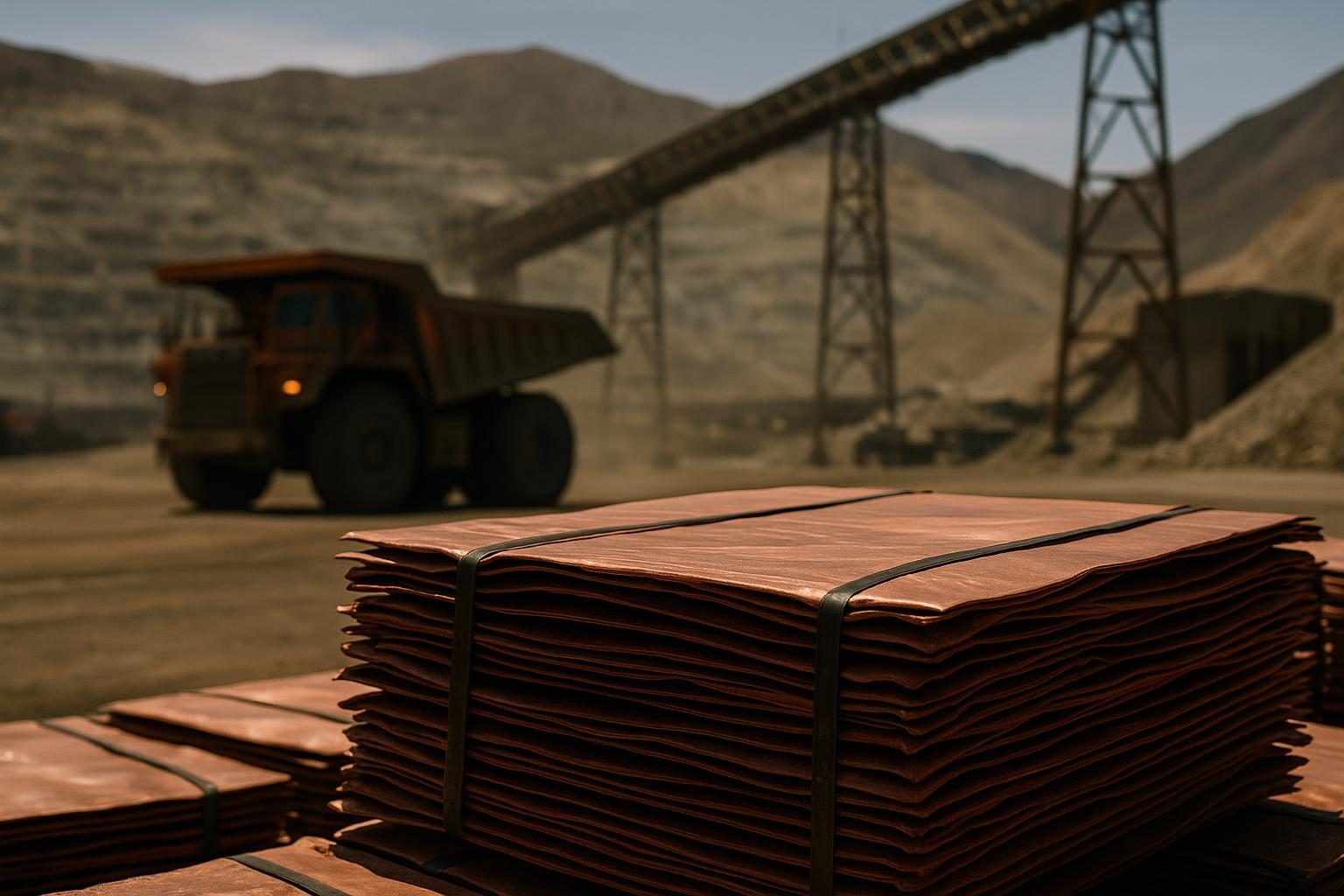
Reuters reported that beneath the dry terrain of northern Chile lies a treasure that the modern world cannot do without: copper. This versatile metal, essential to everything from smartphones to wind turbines, is central to our transition to a green economy. Now, BHP's Escondida mine, the largest in the world, is sounding the alarm on the urgent need for regulatory predictability in Chile. As the demand for copper is set to nearly double by 2050, the stability of this vital industry depends on the decisions made today.
The Copper Conundrum: Balancing Demand with Supply Constraints
At the heart of BHP's appeal for regulatory certainty is the expectation that copper demand will surge to 50 million tonnes annually by 2050. According to Mining Weekly, Alejandro Tapia, head of the Escondida mine, highlighted that while the appetite for copper is poised to grow due to green energy and digitalization, the supply side faces significant hurdles. Aging deposits and the increasing complexity of ore extraction threaten productivity. Reuters reported that this tug-of-war between supply and demand dynamics highlights a need for stable governance to secure the investment required for expansion.
Chile, which accounts for a substantial portion of global copper output, is under pressure to modernize its regulatory framework. Reuters reported that neither BHP nor other mining giants are asking for relaxed environmental regulations; what they want is a streamlined permitting process that supports sustained investment and operational continuity. BHP alone has earmarked $10 billion in capital projects, including a new concentrator at Escondida, indicative of their commitment to meeting future demand, as reported by Mining Weekly.
A Glimpse into Chile's Mining Challenges
Escondida's call for regulatory clarity highlights broader challenges within Chile's mining industry. The country's mines grapple with deeper excavation requirements, rising operational costs, and a depletion of higher-quality ore. These factors collectively erode existing productivity levels, making capital investment crucial to counter these trends.
Furthermore, Chile must navigate these challenges amid a backdrop of political and social shifts. Discussions on royalty reforms and increased scrutiny over water usage and ecological impact are forcing the industry to adapt rapidly. Reuters reported that as the government works to maintain investor confidence, guaranteeing legal and regulatory predictability is essential. Tapia's remarks at the industry event reflect a growing consensus among corporate executives that predictability will foster an environment conducive to sustainable development.
Global Stakes: Copper Beyond Chile
Reuters reported that while Chile plays a key role in global copper supply, the implications of its regulatory decisions extend well beyond its borders. The International Copper Study Group indicates that the overall stability of copper markets impacts international projects tied to the metal. Innovative technologies in renewable energy and electric vehicles, both crucial for carbon-neutral targets, rely heavily on copper resources.
Reuters reported that BHP’s projections of needing 10 million tonnes of new mined supply over the next decade to meet rising demand are a call for coordinated global effort. As the world pivots toward electrification and digitalization, the robust supply of copper becomes indispensable.
The Path Forward: Collaborating for a Sustainable Future
In the face of these challenges, the solution lies in collaboration between government, industry, and community stakeholders. Reuters reported that lessons from previous regulatory shifts highlight the importance of clear legislative frameworks that align with national development goals and environmental sustainability.
According to BHP, future demand trajectories emphasize shared responsibility in addressing engineering challenges and capital investments necessary for opening new mines and upgrading existing ones. Aligning such investments with streamlined regulatory processes will catalyze progress, and Escondida stands ready to play its part, provided the path forward is predictable and secure.
The resounding message from this complex narrative is the need for dialogue and policy-making that embraces transparency without compromising environmental integrity. In a world where copper's significance is rapidly increasing, the time for decisive action is now. Reuters reported that the stakes are high, especially for Chile, and for the global economy that increasingly relies on the fruits of its mines.
Key Takeaways on Copper's Future
What changed: BHP's $10 billion investment in the Escondida mine is contingent on achieving regulatory certainty in Chile, as global copper demand is projected to surge.
Measurable implication: The need for streamlined permitting processes is critical to secure the necessary capital investments for expanding copper production, especially as demand approaches 50 million tonnes annually by 2050.
Next dated milestone: No dated milestone is scheduled; the signal to watch is the ongoing discussions regarding regulatory reforms in Chile.
Strongest counterargument: Critics argue that increased scrutiny over environmental impacts may hinder the mining sector's ability to meet future copper demands.
Sources
- BHP's Escondida urges regulatory certainty in Chile to boost copper investment — Mining Weekly · 14 August 2026
- BHP expects copper demand to grow by 1 million metric tons a year until 2035 — investing.com · date not available
- BHP Q2 2026 Earnings Call Transcript — tickertrends.io · date not available
MktInvest Research is MktInvest's automated research desk. Every piece is AI-generated and machine-gated — no human byline is implied. How this works →
Get this in your inbox, weekly
The Friday digest: what changed on every market we track — stances, evidence movement and the facts behind it.
Marketing communication for informational purposes. It does not constitute financial advice or a personalised recommendation (MiFID II). Exposures are discussed at asset-class/ETF level only.